

Déjà Vu on Inflation?
Déjà Vu on Inflation?
Emerging Markets Showing Faster Policy Reflexes
Inflation is stirring again, but in many emerging markets, policymakers are already moving with greater urgency and more established inflation-fighting reflexes than many advanced-economy peers.
Déjà vu may be an overused phrase in markets, but it feels apt again. Higher commodity prices following disruptions to traffic through the Hormuz Strait have pushed the global inflation outlook higher. This has revived memories of the post-Covid episode, when commodity prices rose sharply and were later compounded by the fallout from Russia’s war in Ukraine. The start of talks between the US and Iran, alongside the announced reopening of the Hormuz Strait, has brought some relief to commodity prices. However, the impact on inflation is already visible, and the question of how quickly inflation developments normalize remains open; one thing is clear: room for policy error is now much more limited, given the post-2021 inflation acceleration.
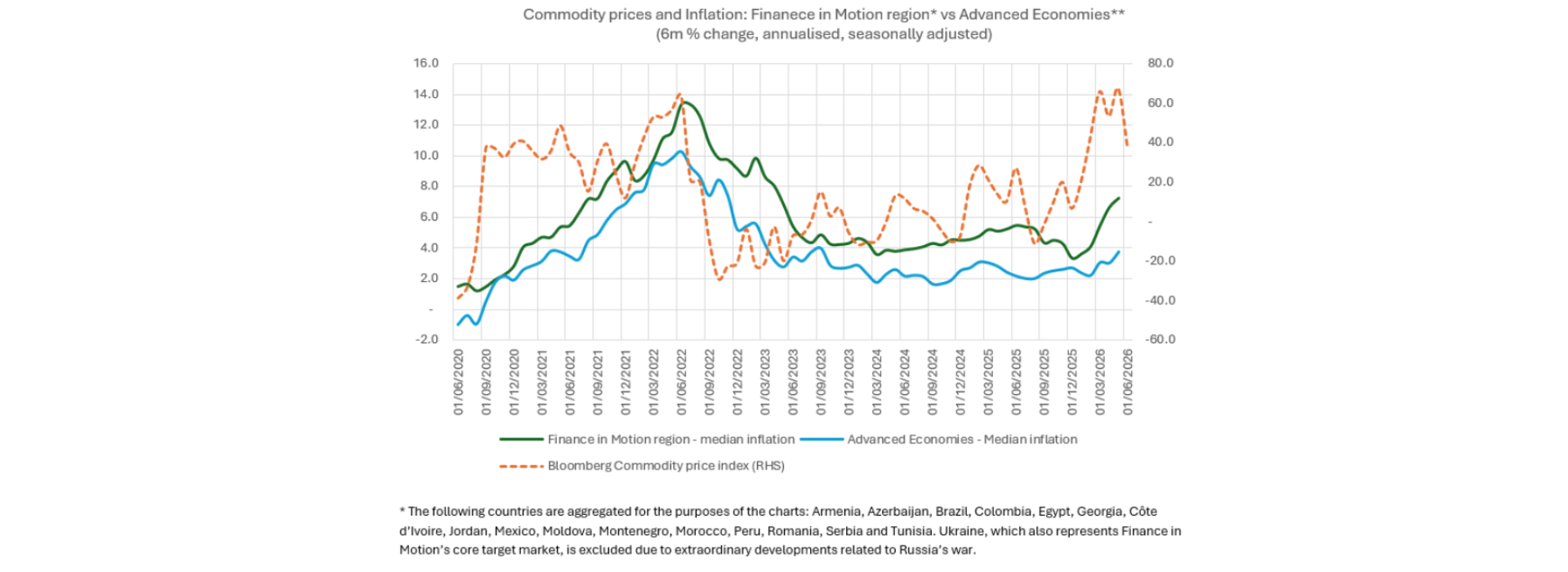
In the aftermath of the pandemic and the energy and food shock triggered by Russia’s war against Ukraine, inflation accelerated rapidly across both emerging and advanced economies. But the policy response was not symmetrical. Many central banks in emerging markets began tightening earlier, and with greater conviction, than the major advanced-economy central banks. That early action mattered. It helped contain second-round effects, supported currency stability, and crucially, signaled that inflation expectations would not be allowed to drift.
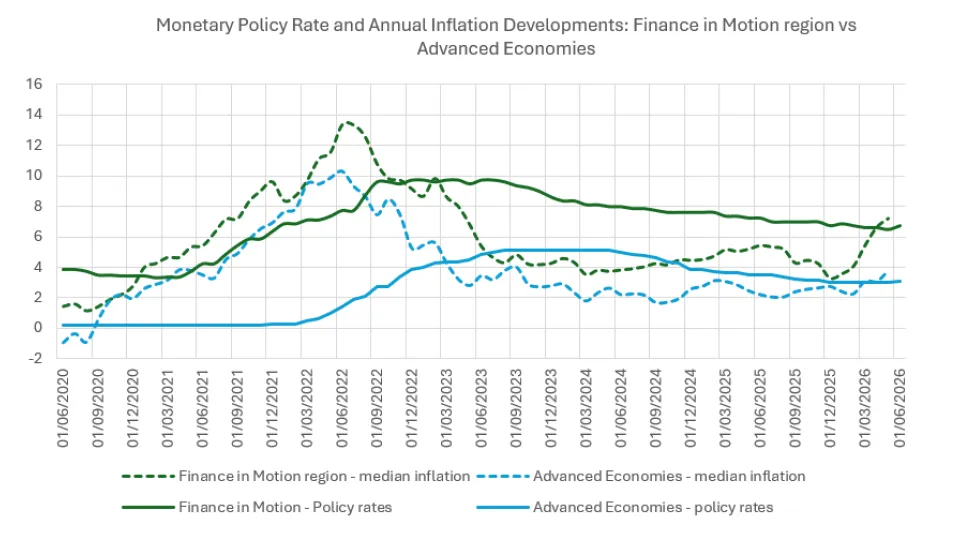
Policy discipline shaped by experience
There are structural reasons for this apparent lead. Unlike many advanced economies, emerging markets have lived through repeated episodes of inflation, currency volatility, and capital outflows. That history has created stronger institutional reflexes. Policymakers in these markets are often more attuned to the speed with which exchange-rate depreciation, imported energy costs or food-price shocks can feed into broader inflation. In other words, they have less room for complacency, and often less political tolerance for falling behind the curve. The International Monetary Fund has noted that stronger monetary policy frameworks have been central to the resilience many emerging markets have shown in recent years.
Once again, the pattern is being repeated. Commodity prices are rising again, and the global policy environment is becoming more uncertain. Yet some of Finance in Motion’s target markets are once again showing early vigilance. The central banks of Georgia and Moldova, for example, have already delivered rate increases, while many others have signaled their readiness to act against renewed inflation pressures.
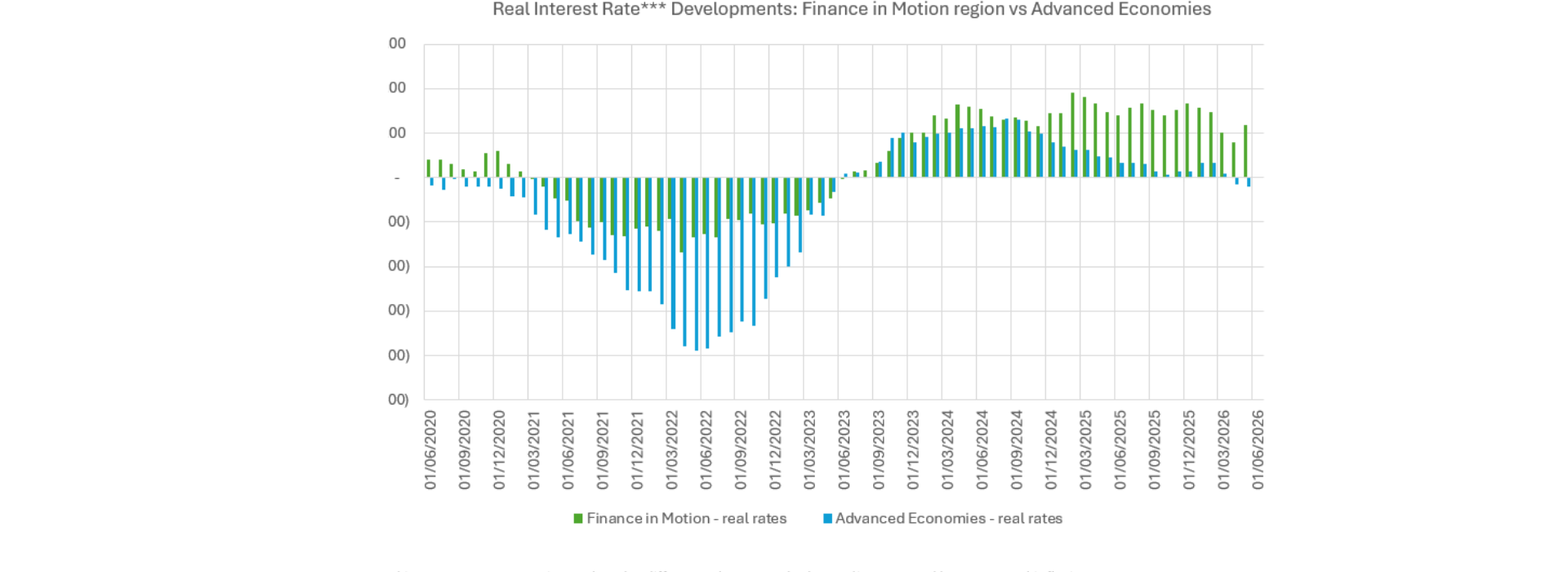
*** Real interest rates are estimated as the difference between the key policy rate and latest annual inflation.
An important difference from the previous inflation cycle is the starting point. Many of Finance in Motion’s target markets enter the current period of commodity-price pressures with significantly positive real interest rates and inflation much closer to, or even below, central bank targets than was the case in 2021. Earlier and more forceful tightening in the previous cycle helped restore price stability, allowing policymakers to retain a degree of policy credibility and flexibility. This provides an additional buffer should commodity-driven inflation prove persistent. Rather than having to catch up with rapidly rising inflation, many central banks across Finance in Motion’s target markets are beginning from a position where monetary policy remains meaningfully restrictive. That does not eliminate risks, but it gives policymakers more room to calibrate their response and reduces the likelihood that inflation expectations become unanchored.
That does not mean all emerging markets are ahead, nor that the risks are lower. Commodity shocks still hit these economies hard, especially where food and fuel account for a larger share of household spending. But this sensitivity can itself produce better policy discipline. In many advanced economies, central banks spent much of the last cycle debating whether inflation would prove transitory. In emerging markets, the memory of past inflation episodes made that a harder assumption to sustain. As a result, several were able to bring inflation back toward target sooner, creating room to begin easing before the US Federal Reserve and other major central banks.
That is significant not only as a near-term market signal, but also as a reminder that today’s emerging markets should not be viewed through outdated assumptions. In many cases, they are not lagging advanced economies; they are offering a preview of how disciplined macroeconomic management looks in a more volatile world. If this is déjà vu, it is not because these markets are repeating old vulnerabilities, but because they are once again reacting faster than many advanced economies. For investors, that matters. It suggests that the resilience of these markets is not simply a cyclical story, but increasingly an institutional one.
Authored by: Aleqsandre Bluashvili, Manager, FX/Treasury
About the Author:
Aleqsandre Bluashvili, CFA, is the Manager in FX/Treasury at Finance in Motion and has over 10 years of experience in Macro Research, Treasury and Capital Markets